


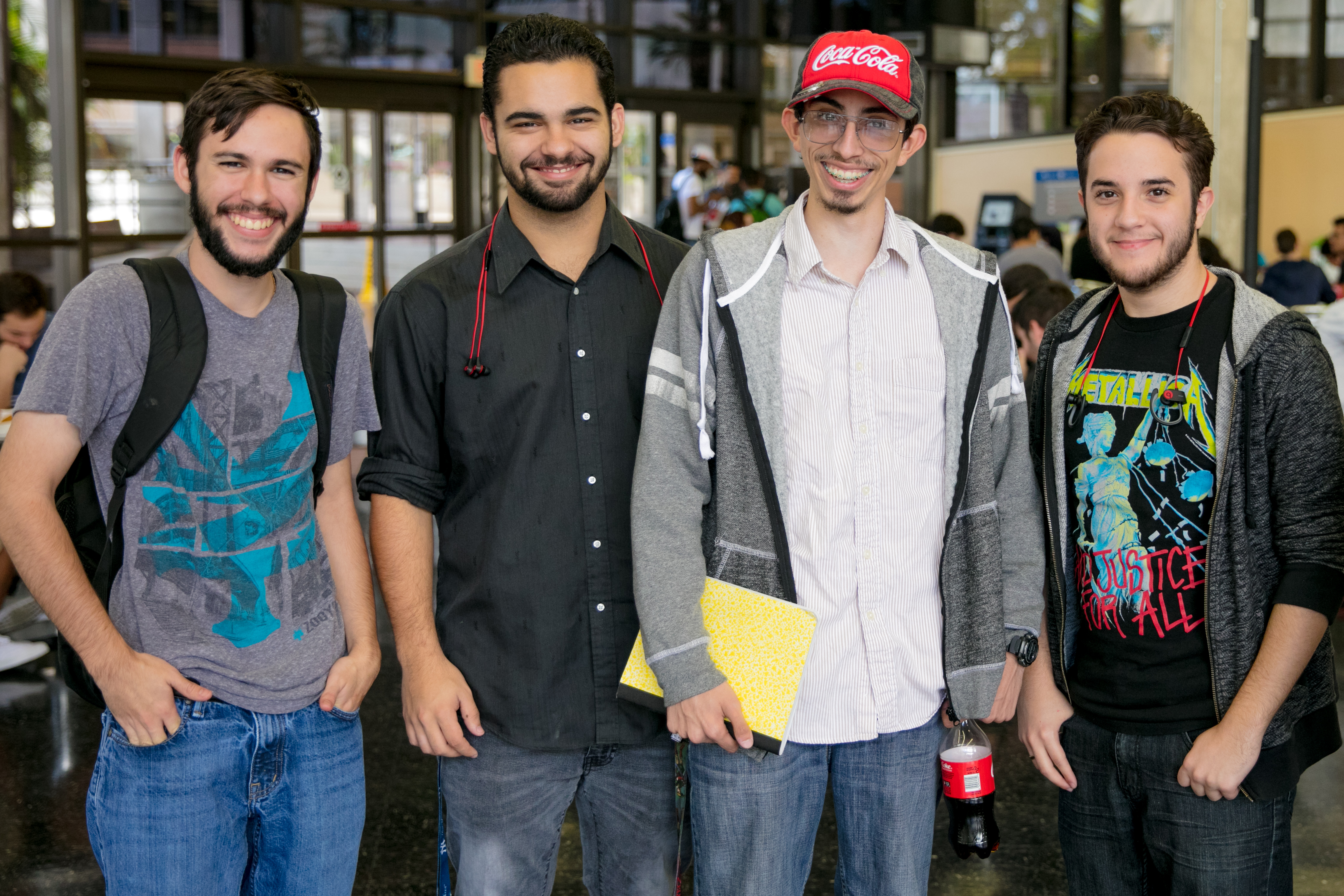
Nineteen-year-old computer science major Kevin Lambert, phone in hand, sits at a red table among a sea of students near building 2000 at Kendall Campus.
Lambert and three other students laugh at the images on his smartphone screen—characters from the video game Overwatch and a still from the critically derided film The Cat in the Hat in the context of a political assassination.
The students are participating in a ritual almost as old as the internet itself; browsing and sharing images paired with text known as memes.
“My day to day life with memes in all honesty…it’s something of a nice gimmick for the day, like I wake up and go to school and before class starts I look something up, laugh and move on with my day,” Lambert said. “It’s more of a feel-good kind of thing.”
Lambert has been browsing memes for years. They have become a key part of his life, as they have for the lives of millions. Long seen as a subculture of the internet, memes have become imbedded into the lives of casual internet users.
The inception of the meme can be traced back across two centuries, way before electronics. From 1831 to 1836, Charles Darwin made his famous expedition to the Galapagos. After research, Darwin came up with a theory of evolution. Darwin’s idea that species evolve and transmutate from others paved the way for people like evolutionary biologist, Richard Dawkins, who wrote a novel on evolution in 1976 called The Selfish Gene. In it, he coined the term, “meme,” likening to the spread of information, surviving through evolution. Memes were later defined by the Merriam-Webster Dictionary as: “An idea, behavior or style that spreads from person to person within a culture.”
“Memes, in a way, have become a form of communication and a way we are able to express ourselves to certain situations,” said Kendall Campus mass communications major Michael Espinoza.
They can come in the form of internet images. Some as simple as a picture of a penguin with white text reading “Night out in Atlantic City…For a Magic: The Gathering tournament” to a screenshot of a Spongebob Squarepants episode with text describing a dire situation from World War II.
“I first got involved with memes about two years ago, when my friends started talking about the latest memes in class,” first-year mass communications/journalism major Melba Silwany said. “Shortly after, the more I scrolled through Instagram or Twitter, the more I started to enjoy the memes that crossed my path.”
Websites like 4chan and apps like iFunny have become homes to thousands and thousands of memes. A dedicated community of “memesters” create and house these pages.
The attention these memes receive range from pure admiration, to social derision. One of the most famous memes of 2016 featured Harambe, a gorilla from the Cincinnati Zoo. He was shot by a zookeeper when a child fell in his enclosure. Hours later, he became an ironic martyr on the internet.
There are more to memes than there appears to be. College-aged students were drawn to the 2016 election memes for their brutally honest humor. This past year, throughout 4chan, images of Donald Trump portrayed as a god, with many of his supporters rallying the site for his victory. Hillary Clinton was the butt of many jokes involving the email scandals. One meme said her scheme to rig the election was deleted with her emails. Even Ted Cruz was subject to ridicule, when several social media outlets proclaimed he was the infamous Zodiac Killer.
“Memes definitely played a role with the millennial point of views for the 2016 election, whether or not we like to admit it,” Silwany said. “Unfortunately, I do feel like it made the election more of a joke than it really was.”
Lambert loves popular culture, but also sees the negative aspects.
“The bad aspect of memes, however, is that most of them can go overboard and be downright offensive,” Lambert said. “I’m not necessarily offended by those dark-humored memes, but I can definitely see people upset over them.”
In 2016, a famous meme, Pepe the Frog, was accused of being a hate symbol.
Elias Diaz, is a 17-year-old Felix Varela Senior High School student, who spends hours a day scrolling through Facebook and iFunny. Diaz has a private Facebook account, which he mostly uses to share memes. No topic is off-limits for him.
“I’ve actually made some people upset at the memes I share, but that’s why the ‘I don’t want to see this’ button exists,” he said. “Whenever I share something there’s only one thing that crosses my mind and that is: ‘Do I find it funny?’ If I say yes, I share it.”
One humorous meme shows nine frames of an anthropomorphic green bean in different poses with the lyrics to rapper Denzel Curry’s “Ultimate.” Others reach much more offensive heights involving jokes surrounding topics ranging from the September 11 attacks to the Holocaust.
Memes have long-since ditched their underground roots. Irony is now the mainstream, with many advertisers embracing meme culture in their ads.
Arby’s has been using video game and internet related images to promote their restaurants on social media.
“I’ve seen what Arby’s does with their marketing. Honestly I think it’s really awesome. It’s not cringeworthy or anything of the sort, too, so that’s a plus,” Lambert said.
Most memes have a recurring theme—to take people out of their lives. To some, it is a funny thing to pass the time. To others, it is a way of life.
“People dedicate their time to post random, funny images, whether it’s dark humor or otherwise, for others to enjoy,” Lambert said.