
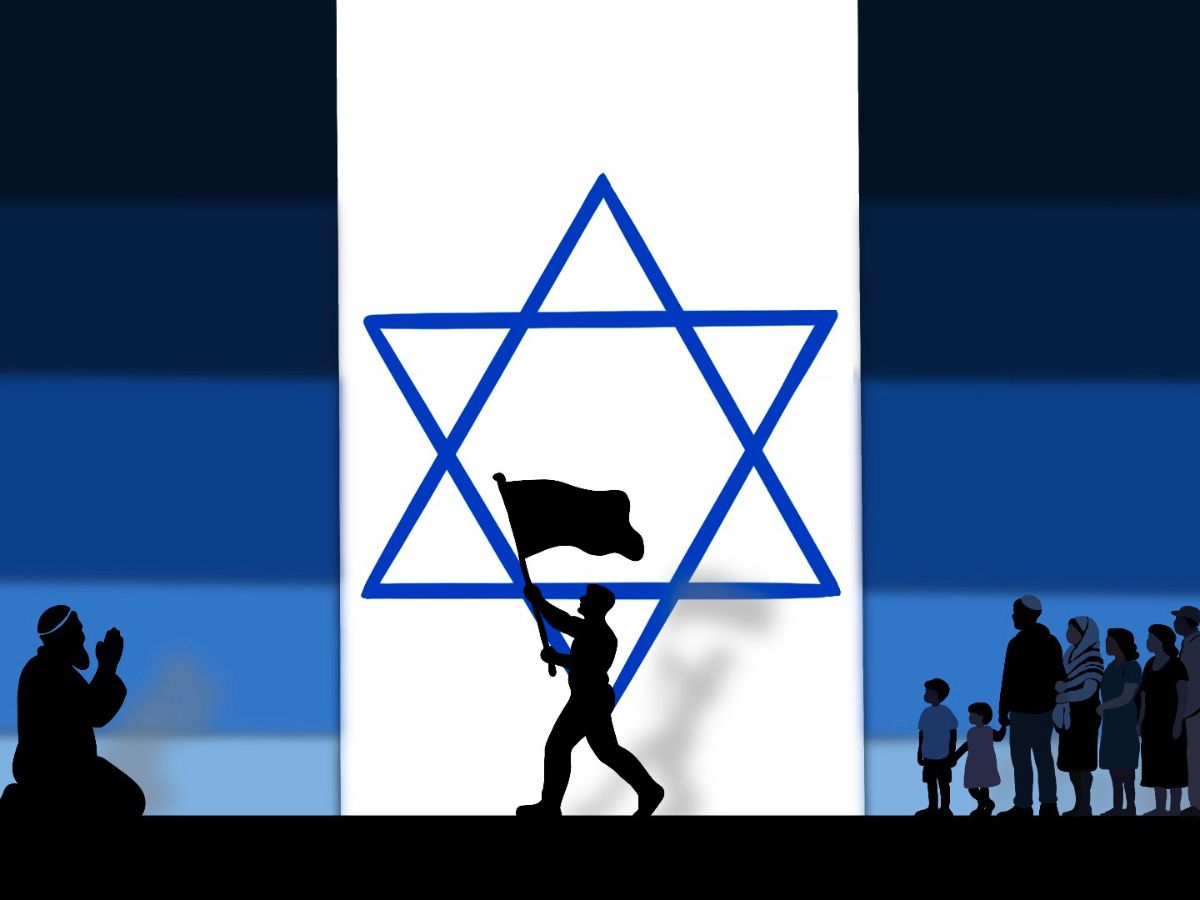
Oftentimes in political conversations, Judaism and Zionism are referred to as the same thing, especially on social media; the minute a person criticizes Israel they’re accused of being “anti‐Jewish” or worse, antisemitic.
But that’s not how it works.
Judaism is a religion and a cultural identity that has existed for thousands of years. Zionism is a modern political movement that seeks the establishment of a Jewish state in historic Palestine.
Being Jewish can mean many different things. For some it’s strict religious practice tied to daily rituals, prayer and Jewish law. For others it’s more about culture, family, food, language or a shared history of exile and survival.
There are secular, agnostic and even atheist Jews who feel a deep connection to their cultural identity, without feeling restricted to a certain political side.
As a Jew, I don’t feel obliged to prove my heritage or the need to defend every Israeli policy.
Some Jews support the idea of a Jewish state; others don’t. There is no single Jewish position on Zionism.
For many Jews, especially after the Holocaust, that idea felt like a matter of survival. A Jewish state could offer protection, sovereignty and a place where Jews weren’t always at the mercy of other governments.
Simultaneously, for Palestinians, the creation of a Jewish‐majority state in what they call Palestine has meant displacement, occupation and the loss of land and rights.
According to TBS News Zionism is a political project focused on Jewish self‐determination in the land of Israel and Palestine while Zionism is a political ideology tied to questions of borders and demographic control.
Understanding the difference is essential.
Criticism of Zionism or of Israeli government policy is often automatically labeled as antisemitism, but institutions that like the Anne Frank House—a museum dedicated to educating against antisemitism—make a careful distinction.
They point out that not all Jews are Zionists and that no Jew should be held personally responsible for the decisions of the Israeli government.
Just as no Palestinian should be held responsible for the actions of Hamas or other armed groups, no Jew should be treated as a representative of Israel’s policies.
TBS News also points out that Judaism existed long before modern Zionism.
For centuries, Jews lived as a diaspora, often without a state and still maintained a rich religious and cultural life. They believed in assimilation, socialism or simply staying in their current countries as minorities.
Jewish identity today is shaped by centuries of exile, persecution and more recently, by the existence of a state caught in an ongoing conflict.
When we talk about Israel, we should be able to talk about a state, its government, and its military without collapsing that entire discussion into “the Jews.”
When we talk about Palestinians, we should be able to talk about a people, a nation and a political struggle without erasing their complexity into a single caricature.
Zionism is an ideology about statehood. They overlap, sometimes deeply, but they are not the same.
Recognizing that difference is not just academic—it’s the starting point for any honest conversation about Israel, Palestine and the people who live in both of those stories.