Wolfson Archivist Retires After Chronicling MDC’s History For 18 Years
By Pietra Romano and Yazid Guelida
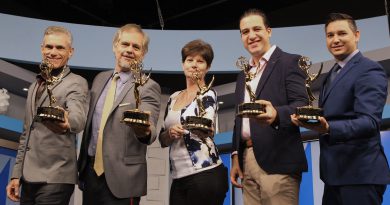
Rene Ramos cataloged Miami Dade College’s history for the past 18 years.
As director of the Lynn and Louis Wolfson II Florida Moving Image Archives, located at the College’s downtown campus, he curated the school’s personal history vault.
During his tenure, the 64-year-old oversaw the digitization of more than 120,000 images and video footage that recount South Florida’s history. From images of the Overseas Railroad built by Henry Flagler to footage of President Barack Obama’s commencement address to MDC graduates in 2011, Ramos has seen it all.
In October, the archives guru took his final bow. He retired from the College after 27 years.
“From the little tiny rooms in the basement of the main library, to having this amazing facility to use and store and save all of this precious film, that was all him—under his leadership, and the team he created, and it will go on,” said Natalka Straczynski, an archives coordinator at the Wolfson Archives.
Ramos’ journey at MDC began in 1982 where he majored in visual arts. He completed 45 credits at North Campus before transferring to Florida International University; he graduated in 1989 with a bachelor’s degree in general studies and humanities.
While at FIU, he helped manage the computer systems of the Latin American and Caribbean Center.
“Nobody knew how to use it,” Ramos recalls. “I didn’t really know how to use it [either], but I decided, ‘Hey, you know, I’m gonna study this and figure this out.”
As his responsibilities grew, he met FIU’s director of computer systems and services, Jacqueline Zelman. The duo collaborated in 1994 to create one of the university’s first websites. The site provided information about the Summit of Americas, a gathering of presidents from Latin America and the Caribbean, that was hosted in Miami that year.
In 1997, Ramos began working at Communications Week Latinoamérica—a magazine focused on communications and information technology—as managing editor.
After the magazine went out of business a year later, he reconnected with Zelman, who was now the chief information officer at MDC.
“I called Jacqueline and said ‘Hey, can I have a reference?’ and she said, ‘Actually, would you like to have a job?’” Ramos said. “Jacqueline hired me to run the website for Miami Dade College.”
He served as senior group manager of web services, overseeing the programmers who created the first website that allowed students to register online for classes.
But by 2007, Ramos was in search of a new challenge.
“There was an opening for the College archivist, and I decided…you know, I really love this institution, I want to help preserve its history, and it’s a job that would still allow me to be involved with technology,” Ramos said.
For two years, Ramos and his team worked in the basement of the Miami-Dade Public Library System’s Main Branch.
However, in 2009, they got a change of scenery when Lynn and Louis Wolfson II gifted MDC a brand new facility—the Wolfson Archives. The 9,000-square-foot space includes a humidity-resistant room kept at 60°F to properly preserve materials.
“I didn’t know anything about film, I didn’t know anything about television materials, but all of a sudden I have this collection of 23 million feet of film and 35,000 hours of videotape and all of this other stuff,” Ramos said.
That same year, the Wolfson Archives began their digitization project. Ramos created a digital catalog with thousands of archived photo and video material that is accessible to the public. The site allows anyone to use the material as a resource for projects, documentaries and reports.
“With Rene driving the development of our digitization plan, we were able to put a preliminary workflow in place before we even moved into our current facility on the Wolfson Campus,” said Archives manager Lou Ellen Kramer. “You can be anywhere and search our online catalog via our website, thanks to Rene’s efforts.”
Ramos’ colleagues describe him as kind, thoughtful and compassionate.
“My youngest son was studying engineering [at MDC]. There were things I couldn’t answer for him, and he would come and talk to Rene,” Straczynski said. “It was amazing. They became like [a] student and mentor. When my son’s dog died, [Rene] painted that dog for him. I shipped it to Wisconsin where he was working.”
Recently, Ramos provided material for the exhibitions at the Freedom Tower, covering the history of the 100-year-old building and the immigrants processed through it.
“I interviewed close to 200 people for that project,” Ramos said. “[The digital stories] have been used to build the experience that you have when you walk through that museum.”
After the project, Ramos decided it was time to retire.
“I still am in disbelief when I come and the office is empty,” Straczynski said. “When you come in and [you have trouble] with your assignment, you could always go to him. That open-door feeling—yes, we’re going to miss that.”
In retirement, Ramos plans to help at museums and spend more time with his two granddaughters.
“We are all mortal, right? All of us eventually die, but this is kind of a small way to achieve a little bit of immortality,” Ramos said. “That’s one of the greatest things about archive work, is that your work will outlast you.”
Click here to subscribe to our bi-weekly newsletter, The Hammerhead. For news tips, contact us at mdc.thereporter@gmail.com.